
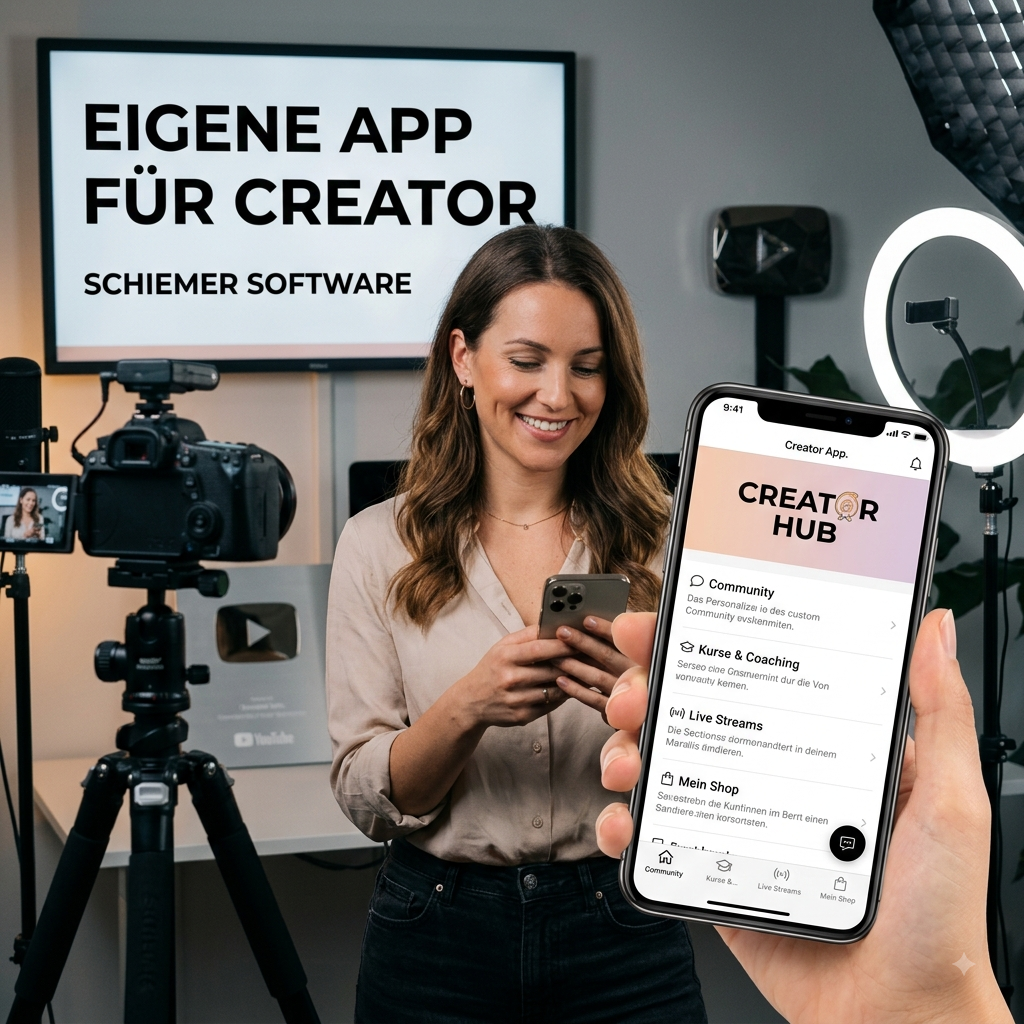
Your reach does not belong to you. That is not pessimism, it is simply how every social media platform works: who sees your content is decided by a recommendation system whose rules can change without anyone asking you. As long as things go well, this never comes up. It comes up on the day an announcement that would have reached tens of thousands a year ago quietly disappears into a niche.
That is why more and more creators manage their content, their products, and their community through their own app. Not because an app does anything magical, but because an install on the home screen is a relationship nobody in between can switch off. What that gives you in practice, how quickly reach turns into installs, what actually leaves more of the revenue with you, and when a good website is entirely enough: we will go through all of it in order.
What your own app can do that a profile cannot
The difference is not in the feature list. It is in who makes the rules. On someone else’s platform you work inside a template: certain formats, certain lengths, certain ways to sell, and a recommendation system that decides who sees you at all. In your own app, those boundaries fall away. In concrete terms:
- Ad space on your own terms: you present sponsorships and your own offers the way your brand calls for, and you keep the full revenue from them.
- Direct communication: an announcement, a new piece of content, or a product launch reaches the people who installed your app immediately, with no recommendation algorithm in between.
- Control over the path to purchase: from first contact through the product page to the order, every step lives in your own application. You can improve the point where people actually drop off, rather than the point a platform currently lets you touch.
- Creative freedom: features that fit your particular community can be built even if they exist nowhere else. This is the hardest one to measure and often the one that decides the matter.
On that last point, the division of labor matters to us: the creative ideas come from you. You know what your community wants, we know how to build it. Our job is to realize your concept the way you meant it, not to press it into a template we already have lying around.
From visibility to installs: why the distance is short for you
The most expensive part of an app is usually not the development. It is the route to the first users. Companies pay for advertising to get there, often for months. In your case that line item is largely paid off already, because you have the attention. A recommendation from your own channel also lands differently than a bought ad, because it comes from someone people already chose to follow.
That shifts the whole calculation. Where a company without an audience needs a marketing budget before its app stands any chance, you can prompt the install directly out of the content you are already making. Do not expect everyone to come along, though. Part of your audience will not install anything, and that is fine. It is exactly the point of what comes next: the app is not aimed at everyone, but at the people where the closer contact is worth having.
What is left of the revenue: a worked example
If you sell something, your sales channel helps decide how much stays with you. On third-party marketplaces and platforms, you pay a commission on every order. Through your own app or website, you essentially pay your payment provider’s fee. Per order the gap looks small. Across a year it is substantial.
The table below is a model, not the results of a real project. It assumes 1,000 orders a year with an average basket of CHF 60, so CHF 60,000 in annual revenue. Marketplace commissions and payment provider fees vary considerably by provider, country, and product category. The rates used are deliberately round assumptions.
| Sales channel | Assumed rate | Cost on CHF 60,000 in revenue |
|---|---|---|
| Physical product through a third-party marketplace | 12% commission | CHF 7,200 |
| Physical product through your own app or website | 2.5% payment fee | CHF 1,500 |
| Digital product bought through the app store, reduced rate | 15% commission | CHF 9,000 |
| Digital product bought through the app store, standard rate | 30% commission | CHF 18,000 |
| Digital product sold through your own web checkout | 2.5% payment fee | CHF 1,500 |
For physical products such as merchandise, roughly CHF 5,700 more stays with you each year in this model. That advantage is genuinely available, because Apple and Google take no commission at all on physical goods or on services delivered outside the app. Both companies’ rules go further and explicitly require that such purchases be handled outside the store’s payment system. So if you sell physical products, you are not saving on the app store. You are saving on the commissions charged by the marketplaces and platforms that would otherwise sit in between.
Digital products are a different story, and here we stay honest. For digital content consumed inside the app, the stores take their share. With Apple that is 30 percent, reduced to 15 percent for developers who earned no more than one million US dollars in the previous year. Google Play uses a comparable model of a standard rate and a reduced rate. Selling through your own website stays clearly cheaper, but the route there is regulated and varies by region on top of that. These detailed rules change regularly, which is why we deliberately do not spread them out here. For your specific plan, we clarify them upfront.
And one piece of context belongs here: the fees you save have to cover the app’s development and operation first. At CHF 5,700 a year, that is a calculation across several years. An app usually becomes financially interesting when a second effect joins the savings: additional revenue from the recurring contact you would not have had without the app. If your only goal is to cut the commission, do the math first. If you also want to deepen the relationship with your community, you are working with two effects rather than one.
The honest objection: would a website not do?
Very often: yes, at least to begin with. Almost everything up to this point can also be solved with a good website. It is cheaper to start, reachable immediately, and needs no store approval and no installation. If you want to sell merchandise or a course today, that is the faster route.
The difference does not show up on the first visit. It shows up on the tenth. A website gets opened when someone happens to think of it, and then the contact is over. An installed app stays visible, is allowed to reach the lock screen with a short message, and therefore gets used regularly rather than once. Playful elements such as points, streaks, or badges can reinforce that recurring contact further. This gap between a short visit and a lasting relationship is the actual reason to build an app.
That leads to the route we recommend in many cases: the website first, the app afterward. The website covers the breadth, is open to everyone, and has the lowest barrier to entry. The app then covers the depth, with the advanced features for the people who genuinely want to stick around. It is a funnel that works well: reach many people, convert a portion of them into installs, and then work with that portion for the long run.
This staged route only works if the website is built from the start so it can become the app later. Otherwise everything starts over in two years. Our article on mobile app development for iOS, Android, and web from one build covers how we handle that technically. If you want to size up the web part first, our overview of website costs and the factors behind them is the better starting point.
How to tell whether your own app is worth it
Instead of a blanket recommendation, here are the signals that, in our view, argue for an app. The more of them apply to you, the more likely the effort pays for itself.
- You already have an audience. An app does not attract new people on its own. It deepens a relationship that is already there.
- You sell regularly and pay commissions for it today. Then the advantage can be calculated rather than assumed.
- Your community should come back, not just drop by. If your offer lives on regular contact, the install is worth the effort.
- You have an idea no platform makes room for. That is where your own application pays off fastest.
- You want to depend less on a single platform. That is a strategic reason rather than a financial one, and for many people the most important one.
If little of this applies, a good website is the right answer. We will tell you so even when you arrive with a finished app idea.
Conclusion: reach becomes something you own
Your own app turns borrowed visibility into a platform you set the rules for. You reach your community directly, you shape features around your idea rather than someone else’s template, and more of your revenue stays with you on every sale. None of it is automatic: the savings have to cover the development, and part of your audience will not install anything. But these are advantages a website cannot offer in the same form.
At Schiemer Software we build exactly these kinds of platforms, from a single shared foundation for Android, iPhone, and the browser, and we can handle the store release and the ongoing support afterward. You can read how we generally work in our article on custom software solutions.
Tell us your idea. We will tell you honestly whether a website is enough, whether an app adds up at your size, or whether the staged route through both is the smarter start. Preparing a quote is free and comes with no obligation.