
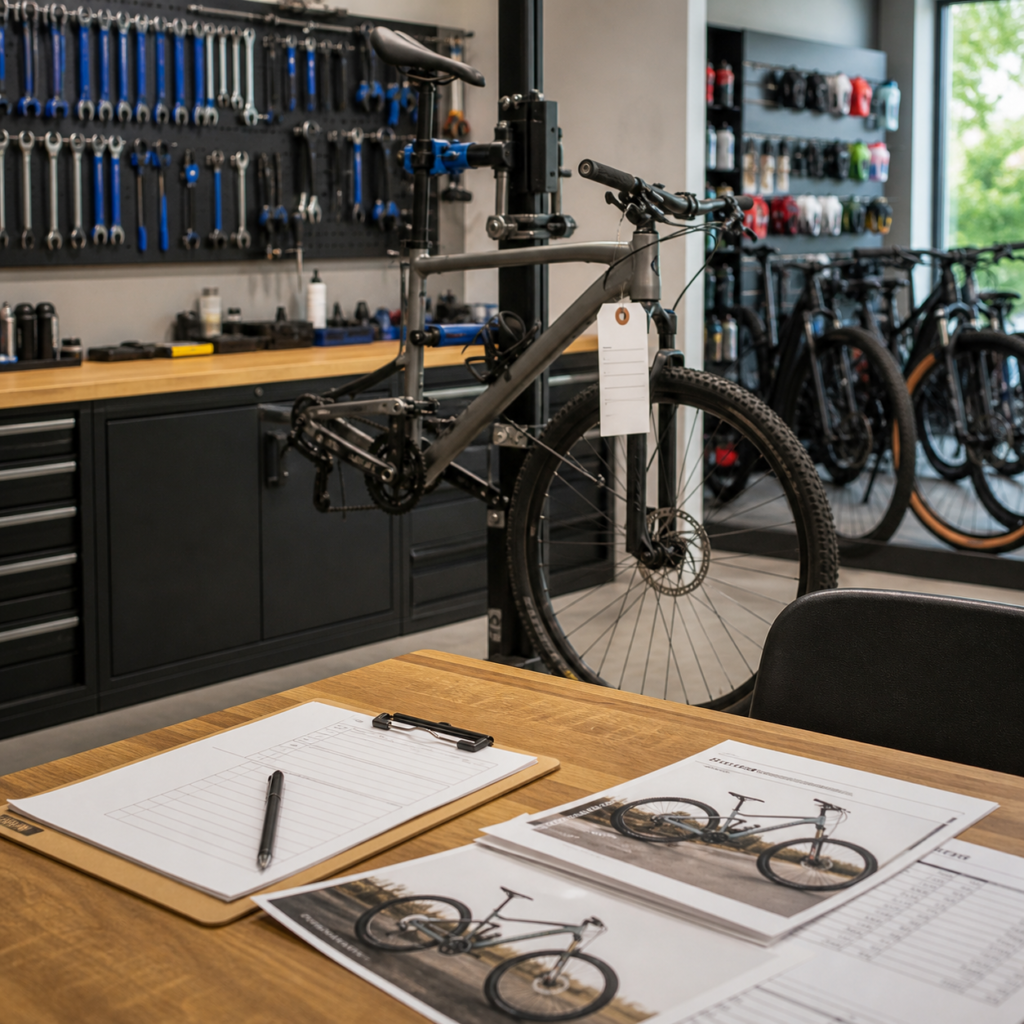
Not every software question in a bicycle shop needs to be answered with a large inventory system. Sometimes the bottleneck is much more specific: workshop intake should be simpler. Or customers should be able to see and compare bikes even though those bikes have not arrived yet or are stored away.
That is where focused workshop and sales apps can help. This assessment is based on practical experience with bicycle businesses in Vorarlberg, Austria. These tools do not necessarily replace your entire software setup; they solve a clear part of daily work in a simpler, faster and more customer-friendly way.
If you want to clarify the overall strategy first
This article focuses on two concrete solutions. If you are still deciding which software a bicycle shop needs in general, start with the article on choosing bicycle shop software. If your main problem is data exchange between systems, read the article on Veloconnect and bicycle software integrations.
Workshop software: record customers, bikes and services simply
In the workshop, clarity matters. Which bike belongs to which customer? Which service was discussed? What has already been done? What information does the team need at the next contact? A lean workshop app can record exactly this information without turning the task into a full inventory-software project.
The Schiemer Software Workshop App is designed to record customers, bikes and service work independently of other systems. That makes it interesting when a shop wants a simple dedicated workflow for the workshop.
Sales app: show bikes before they are on the showroom floor
Sales creates a different problem. A bike has been ordered but has not arrived yet. Or bikes are stored away in winter while the store is focused on ski sales. Customers may still want to see, compare and reserve bikes.
The Schiemer Software Bikeshop Sales App is built for that moment. On a tablet or similar device, available and ordered bikes can be presented with images, availability and delivery dates. Based on the current product claim and my own knowledge, one special promise of the app is that all images of the respective bike are shown.
For customers, consultation becomes more tangible. They do not have to imagine a model from a product line alone; they can compare variants visually. For the shop, the consultation feels more modern and structured, without every bike needing to be physically present in the showroom.
Avoid manually updating delivery dates again and again
Changed delivery dates are a common pain point in bicycle retail. When manufacturer data changes, manual updates quickly follow. The sales app is designed to track bicycle data continuously and display availability and delivery dates correctly, as long as the underlying data is available.
This does not replace clean data sources, but it reduces recurring sales work. For seasonal retailers, that can matter a lot: consult in winter, deliver in summer, and keep reservations and expectations visible in between.
Why focused tools can also suit smaller retailers
Large retailers and sports chains often have their own digital sales tools. Smaller bicycle shops do not have to introduce a huge system to improve. A focused tool can be enough to appear more modern, improve consultation and structure internal work.
The important part is defining the role clearly. A workshop app is not a complete replacement for accounting or POS. A sales app is not a classic online store. Both can help exactly where standard software feels too heavy or where one process deserves more attention.
FAQ
Does the workshop app replace inventory software?
Not necessarily. It is a focused tool for customers, bikes and service work. Whether you also need inventory software depends on purchasing, stock and availability processes.
Who benefits most from the sales app?
Retailers who want to consult or reserve bikes before those bikes are in the showroom. This is especially useful for seasonal businesses, limited sales space or many ordered models.
Can the app compensate for missing manufacturer images?
At the moment, images for Cube, Scott and Cannondale bikes are maintained automatically. That can compensate much better for missing or incomplete manufacturer images in those cases. Still, every solution depends on available and maintained data sources, so this should be checked for the specific setup before use.
Conclusion
Workshop software and a sales app solve two very practical questions: How do I record service jobs simply? And how do I advise customers convincingly when bikes are not right in front of them? Improving those processes does not always require a larger overall system. Often it requires a focused tool in the right place.